
Fortress Merge Enemy Types
Every enemy family, their stats, and the defense that counters them.
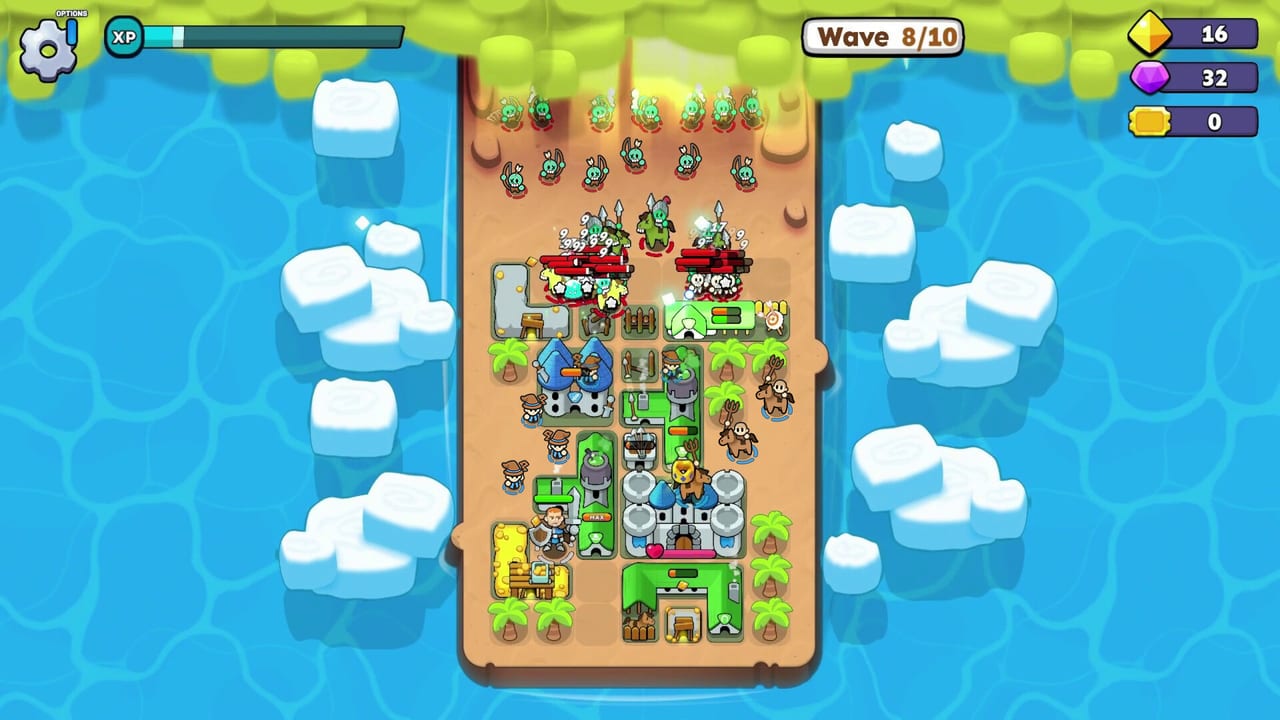
Fortress Merge throws five enemy families at your fortress: skeletons, slimes, dragons, giants, and bosses. Each family has different HP, speed, damage output, and a specific counter. This page tells you which building handles which threat — use it alongside the building tier list and the placement guide.
Skeletons — the baseline
Skeletons are the most common enemy. Low HP, moderate speed, melee attack. A single barricade stops them cold; a Tesla or knight camp cleans them up. They teach you the lane. If skeletons are walking through your wall, the issue is wall HP or placement, not your damage.
Counter: Any stall. Walls, knights, barricades.
Slimes — speed and volume
Slimes come in small and large variants. Small slimes are fast and die to anything. Large slimes have more HP and still move quickly. They arrive in packs. A line of barricades catches them; a Tesla coils the pack for mages to nuke. Slimes do not attack through walls — they chew wood until it breaks.
Counter: Barricades in the lane, Teslas for the clump.
Dragons — area pressure
Dragons fly over ground obstacles. They ignore barricades and knight camps on the lane — they walk straight to the castle. This makes them the most punishing enemy for a board that relies entirely on front-line stall. Mages and archers are your anti-dragon damage. A Tesla behind a wall still hits dragons; a barricade does not.
Counter: Back-row damage (mages, archers, catapults). Tesla placement matters more against dragons than against ground families.
Giants — HP tanks
Giants are slow but extremely durable. They absorb hits from Teslas and mages while walking. They do not attack through walls — they break them. One giant can chew through an unmerged barricade before your Tesla finishes charging. Merge your walls before a giant wave. Giants on a long lane need sustained damage; giants on a short lane need burst.
Counter: Merged walls with HP skills, sustained mage fire, Tesla coils.
Bosses — the wave-10 and wave-13 slams
Bosses appear on wave 10 (standard maps) and waves 8 and 13 (milestone maps). They have large HP pools, area attacks, and the ability to break walls faster than normal enemies. Some bosses slam the front row; others walk around obstacles. The boss guide covers the conversion checklist. Here is the TL;DR:
- Sell mines before boss prep.
- Stack walls on the true lane.
- Hold your hero skill for the boss bar.
- Pick global skills (cooldown, HP) over family-specific buffs.
Counter: Everything. Bosses test the full board — stall, damage, hero skill, and economy management.
How wave composition changes the counter
A wave of pure skeletons needs only walls. A wave of slimes needs stall plus area. A wave of dragons needs back-row damage, not front-line walls. Reading the incoming wave is a skill you develop by watching the first three seconds at 1x speed. The boss guide explains wave composition on milestone maps.
Draft priorities by enemy
When the skill draft pops, match the pick to the enemy:
- Dragon wave incoming → mage radius or back-row damage.
- Giant wave incoming → wall HP or building HP.
- Mixed wave → global cooldown or all-turret damage.
Never take a horseman buff on a mage board. Never take mage radius when dragons are not in the next wave.
Related pages
- Building tier list — what to place.
- Units tier list — what your camps spawn.
- Boss guide — wave 10 and 13 conversion.
- Placement — where to put the counter.
Frequently Asked Questions
Quick answers to the most common questions.
Do dragons ignore walls completely?
Dragons fly over barricades and knight camps. They still take damage from Teslas, mages, and catapults behind the wall.
Are large slimes just bigger HP pools?
Yes, plus they move at the same speed as small slimes. Area damage (mages, catapults) handles packs of slimes more efficiently than single-target Tesla shots.
Can I stall a boss with walls?
Bosses break walls faster than regular enemies. Stack merged walls, add HP skills, and hold your hero skill for the burst phase.